Special Issue: Next-Generation Bio-Based Adhesives for High-Performance Wood-Based Composites
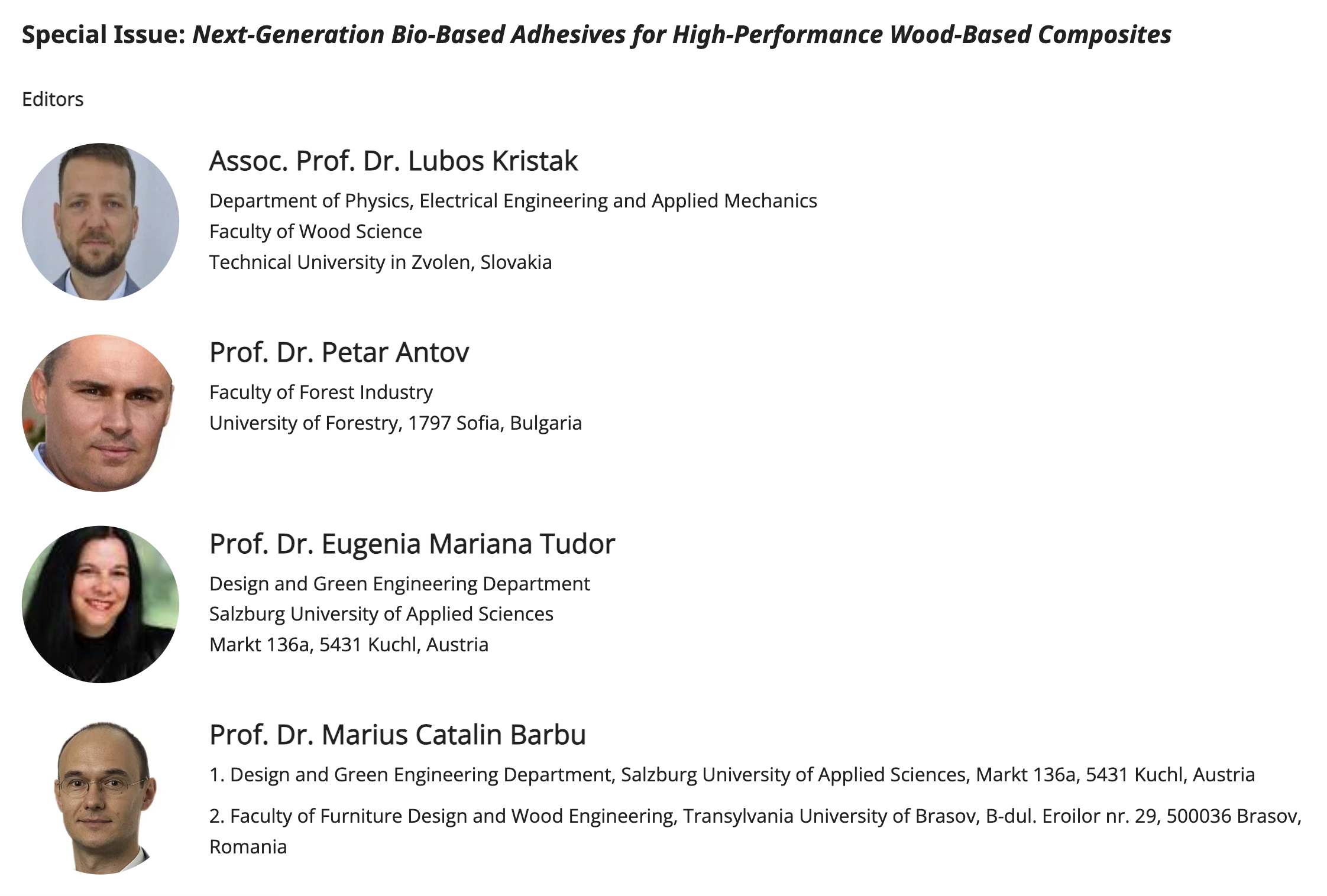 The Special Issue “Next-Generation Bio-Based Adhesives for High-Performance Wood-Based Composites” is committed to publishing high-quality, original research that advances sustainable adhesive technologies for wood-based materials. The issue welcomes interdisciplinary contributions spanning polymer chemistry, wood science, biomass utilization, materials engineering, forestry, and industrial manufacturing, with particular emphasis on solutions that facilitate the transition from fossil-derived adhesives to renewable, bio-based alternatives.
All submitted manuscripts must present original work that has not been previously published or simultaneously submitted elsewhere. Contributions should provide significant scientific novelty, technological innovation, or practical industrial relevance. Studies focusing solely on routine characterization without demonstrating meaningful advances in adhesive performance, processing technology, sustainability, or industrial application may not be considered for publication.
Submissions are expected to demonstrate scientific rigor through appropriate experimental design, statistical analysis, and comprehensive characterization of adhesive systems and wood composite performance. Preference will be given to studies addressing key challenges associated with industrial implementation, including curing behavior, viscosity control, mechanical properties, water resistance, durability, formaldehyde-free formulations, techno-economic feasibility, life-cycle assessment, process optimization, and scale-up potential.
This Special Issue particularly encourages research involving renewable feedstocks such as lignin, tannin, proteins, starch, cellulose, nanocellulose, agricultural residues, forest biomass, and hybrid bio-based adhesive systems. Manuscripts investigating innovative crosslinkers, functional additives, mineral fillers, and other advanced material modifications that significantly improve adhesive performance are also highly encouraged. Research integrating circular bioeconomy principles, biomass valorization, waste utilization, and low-carbon manufacturing approaches is especially welcomed.
The editorial team seeks contributions that bridge the gap between laboratory-scale innovation and industrial application by developing safe, high-performance, and commercially viable bio-based adhesive technologies for the next generation of wood-based composites. Research should clearly demonstrate its potential contribution to improving the sustainability, competitiveness, and industrial adoption of renewable adhesive systems.
All manuscripts submitted to this Special Issue will undergo a rigorous double-blind peer-review process conducted by at least two independent experts. Editorial decisions will be based on scientific quality, originality, methodological soundness, relevance to the Special Issue theme, and compliance with the publication ethics and editorial standards of Jurnal Sylva Lestari. Authors are required to adhere to internationally recognized principles of publication ethics concerning authorship, research integrity, data availability, conflict of interest disclosure, plagiarism prevention, and transparency throughout the submission and review process.