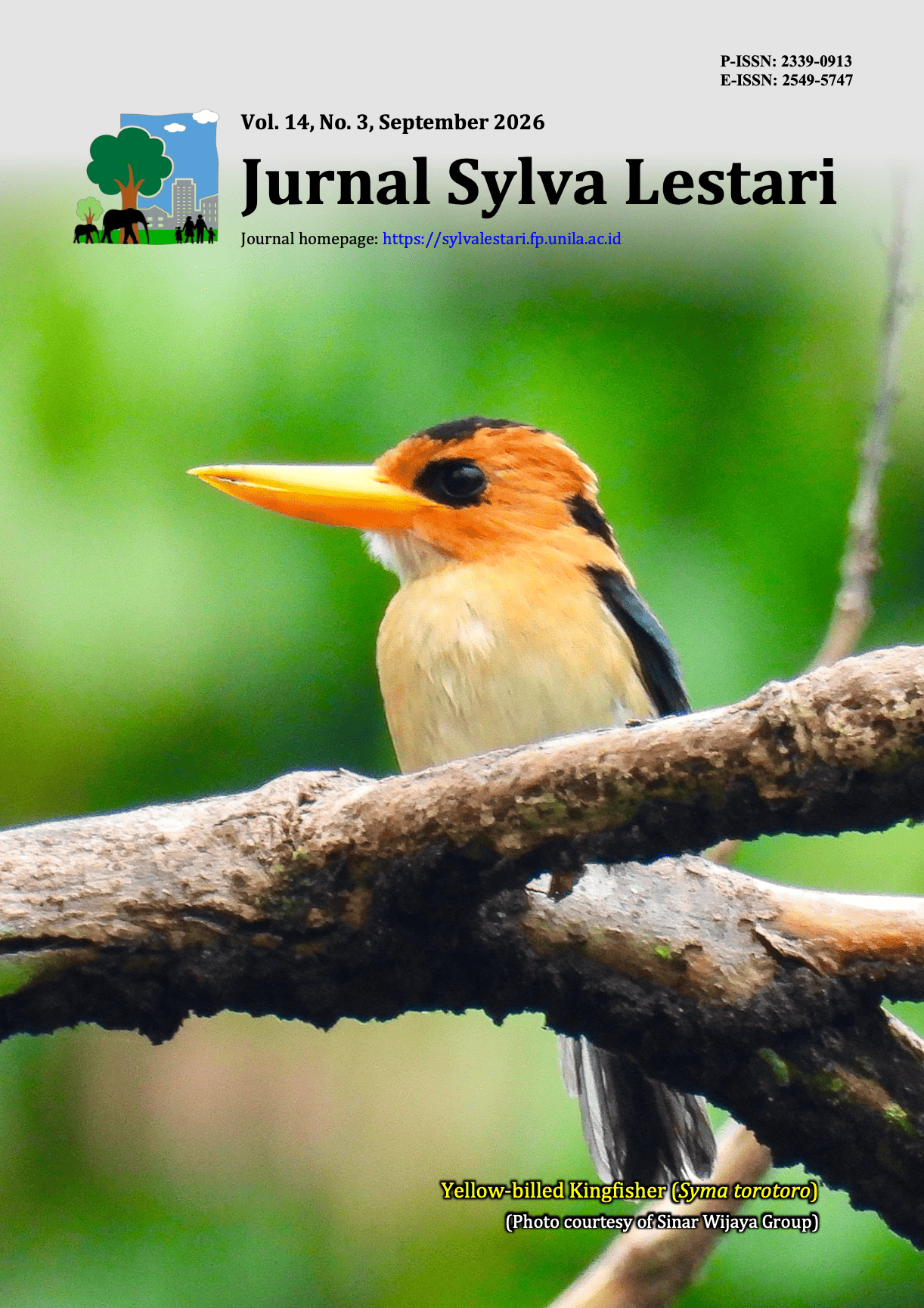
Divergent Development Pathways in Community-Based Forest Tourism under a Common Governance System: A Tourism Area Life Cycle
DOI:
https://doi.org/10.23960/jsl.v14i3.1491Abstract
Understanding the Tourism Area Life Cycle (TALC) in community-based forest tourism is essential for sustainable destination management. Therefore, this study aimed to identify the TALC stage of the Mataram Cultural Forest Tourism area. A mixed-methods approach was employed. Data were collected through interviews with site managers, tourist surveys, questionnaires, direct observation, and document review. The composite index was derived from seven variable groups: visitor numbers, tourist characteristics, attractions, accessibility, amenities, institutional capacity, and community participation. Scores ranged from 12.08 to 61.84, indicating substantial differences in development levels. Bukit Mojo, Bukit Panguk, Pinus Asri, and Lintang Sewu remained at the exploration stage with a declining trend; Seribu Batu was at the involvement stage; Puncak Becici was at the development stage; Pinus Sari was at the consolidation stage; whereas Pinus Pengger showed characteristics indicating a transition toward stagnation. These findings suggest that forest tourism development does not always follow a linear TALC trajectory. Visitor numbers alone cannot fully explain this process. Differences in destination development are more strongly associated with institutional capacity, administrative capability, policy coherence, and community participation. This study demonstrates the heuristic value of TALC and the importance of governance-sensitive forest tourism planning.
Keywords: community participation, destination development stages, forest-based tourism, institutional governance, Tourism Area Life Cycle
Downloads
Downloads
Published
How to Cite
Issue
Section
Statistics
 Abstract views: 170 times
 PDF downloaded: 183 times
Metrics
License
Copyright (c) 2026 Niskan Walid Masruri, Hero Marhaento, Kaharuddin, Muhamad

This work is licensed under a Creative Commons Attribution-NonCommercial 4.0 International License.
Authors retain copyright and grant the journal right of first publication with the work simultaneously licensed under a Creative Commons Attribution-NonCommercial 4.0 Licence that allows others to share the work with an acknowledgement of the work's authorship and initial publication in this journal.
Authors are able to enter into separate, additional contractual arrangements for the non-exclusive distribution of the journal's published version of the work (e.g., post it to an institutional repository or publish it in a book), with an acknowledgement of its initial publication in this journal.
Authors are permitted and encouraged to post their work online (e.g., in institutional repositories or on their website) prior to and during the submission process, as it can lead to productive exchanges, as well as earlier and greater citation of published work (See The Effect of Open Access).